

The average salary in Pakistan is PKR 82,100 per month — roughly USD 292 — as of 2025–2026. The median sits lower at PKR 70,700, meaning half the workforce earns below that figure. These numbers shift considerably based on industry, city, experience, and education level.
This guide breaks down what people actually earn across Pakistan. You’ll get sector-by-sector figures, city comparisons, experience-level ranges, and a real take-home pay calculation after taxes and deductions. If you’re actively looking for work, browse current job openings in Pakistan alongside this data to see what employers are actually offering right now.
Average vs. Median Salary — The Number That Actually Matters
Most salary articles lead with the average. That’s misleading.
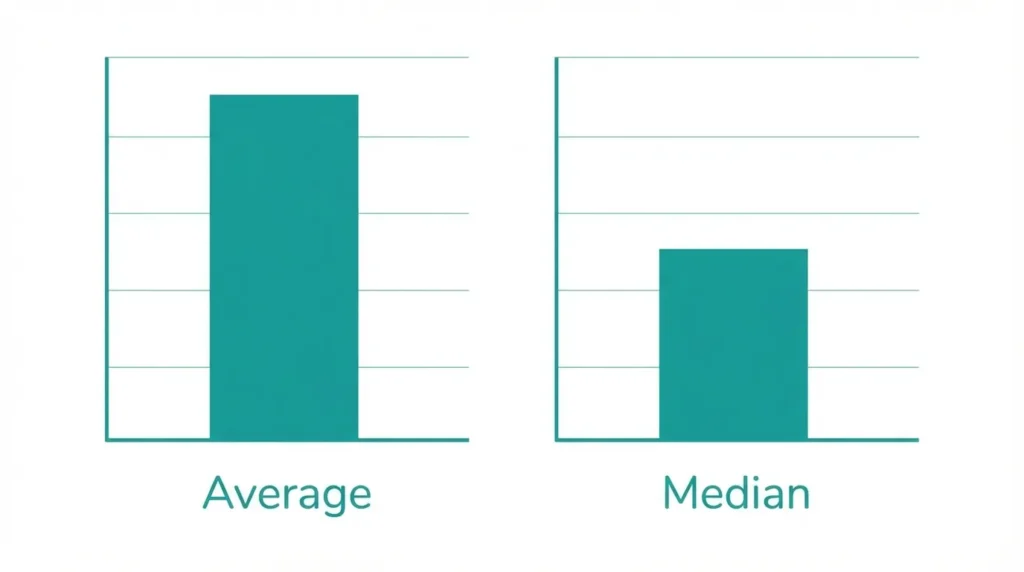
The average is pulled upward by high earners — surgeons, C-suite executives, and senior bankers. When a few people earn PKR 500,000–800,000 per month, the average climbs fast, even if most workers earn far less.
The median is more honest. At PKR 70,700 per month, it shows what a typical worker in the middle of the distribution actually earns.
Here’s the basic picture:
| Metric | Monthly (PKR) | Monthly (USD approx.) |
|---|---|---|
| Average Salary | 82,100 | ~292 |
| Median Salary | 70,700 | ~252 |
| Entry-Level Typical | 35,000–50,000 | ~125–178 |
| Senior Professional | 150,000–350,000 | ~535–1,246 |
When comparing yourself to benchmarks, use the median — not the average — as your reference point. For a precise monthly figure based on your own pay structure, use our salary calculator to run the numbers instantly.
Minimum Wage in Pakistan 2025 — Province by Province
Pakistan’s minimum wage is set at the provincial level, not federally. This creates real differences depending on where someone works.
| Province | Monthly Minimum Wage (PKR) |
|---|---|
| Punjab | 37,000 |
| Sindh | 37,000 |
| Khyber Pakhtunkhwa (KPK) | 36,000 |
| Balochistan | 32,000 |
| Federal Capital (ICT) | 37,000 |
These are legal floors for unskilled workers. Skilled and semi-skilled workers in formal employment typically earn 20–40% above these floors, depending on their trade and employer.
A critical point: these figures apply only to the registered formal economy. Pakistan’s informal sector employs an estimated 70–72% of the total workforce, according to the Labour Force Survey. For informal workers — daily wage laborers, domestic workers, small shop employees — actual pay often falls below even these provincial minimums with no legal enforcement mechanism in practice.
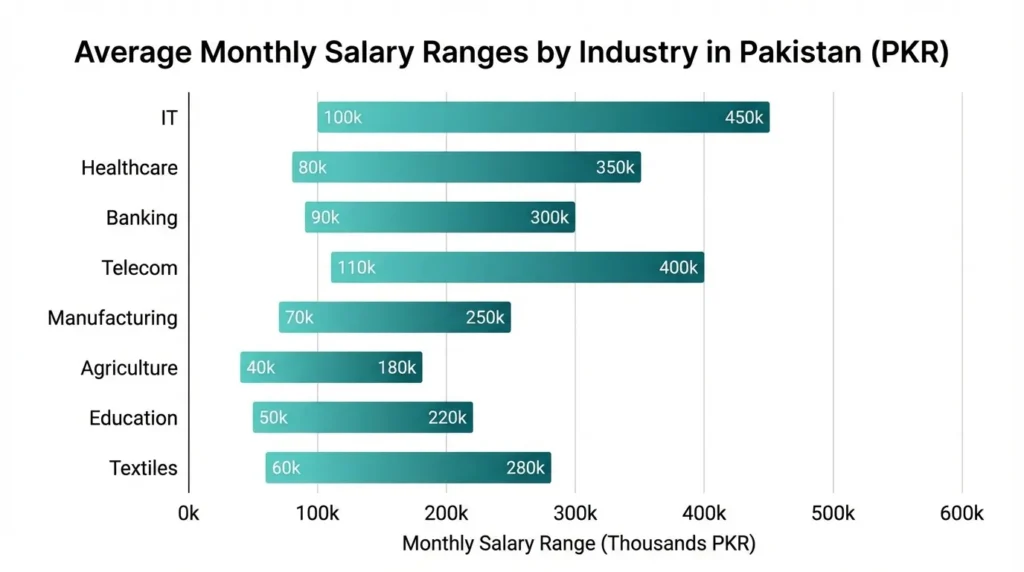
Average Salary by Industry in Pakistan
Industry is the single biggest driver of salary variation. A doctor and a textile worker both live in Lahore. Their incomes are not even in the same bracket.
IT & Software Development
The IT sector pays the highest salaries in Pakistan’s private economy. A junior software developer earns PKR 60,000–100,000 per month. Mid-level developers with 3–5 years of experience earn PKR 120,000–250,000. Senior engineers and architects at top firms or multinationals earn PKR 300,000–600,000.
Pakistan ranks among the world’s top freelance exporting countries. Remote and freelance software work often pays in USD, which is a significant multiplier — a developer billing USD 20–30/hour earns PKR 450,000–675,000 monthly at current exchange rates, far above any domestic benchmark.
Healthcare & Medicine
A general medical officer (GMO) in a government hospital earns between PKR 80,000–130,000 under the BPS system. Private sector doctors in urban clinics earn PKR 150,000–400,000. Specialist consultants — cardiologists, orthopedic surgeons, neurologists — earn PKR 400,000–1,000,000 or more per month in major cities.
Nurses earn PKR 35,000–75,000. Pharmacists earn PKR 50,000–120,000.
Banking & Finance
Entry-level banking officers start at PKR 55,000–80,000. Branch managers earn PKR 150,000–250,000. Senior roles in investment banking, credit risk, and treasury management pay PKR 300,000–600,000. Chartered Accountants (CA) and CFAs command PKR 200,000–500,000 in large financial institutions.
Construction & Manufacturing
This sector employs millions but pays near the wage floor. Skilled tradespeople — electricians, plumbers, welders — earn PKR 45,000–80,000. Site supervisors earn PKR 70,000–130,000. Civil engineers in construction firms earn PKR 80,000–200,000 depending on employer size and project type.
Textile & Manufacturing
Textile is Pakistan’s largest export industry and one of its largest employers. Floor workers earn PKR 35,000–50,000. Machine operators and technicians earn PKR 50,000–80,000. Production managers and quality control supervisors earn PKR 100,000–200,000.
Agriculture
Agriculture employs around 37–38% of Pakistan’s labor force. Most agricultural work is informal, seasonal, and paid by the day or crop cycle. A farm laborer earns PKR 700–1,500 per day. Permanent farm supervisors in larger agricultural operations earn PKR 30,000–60,000. Agricultural engineers and agronomists in agribusiness firms earn PKR 80,000–180,000.
Education
Government school teachers earn PKR 35,000–90,000 depending on grade and BPS level. Private school teachers in mid-tier institutions earn PKR 30,000–70,000. University lecturers in public universities earn PKR 80,000–150,000. Full professors at major universities earn PKR 150,000–300,000.
Telecommunications
Telecom companies — Jazz, Zong, Telenor, Ufone — pay well above the national average. Entry-level engineers and analysts earn PKR 70,000–120,000. Mid-level network engineers and product managers earn PKR 150,000–280,000. Senior directors and VPs earn PKR 350,000–700,000.
Highest-Paying Jobs in Pakistan (Top 10)
| Rank | Profession | Avg. Monthly Salary (PKR) |
|---|---|---|
| 1 | Specialist Doctor / Surgeon | 500,000–1,200,000 |
| 2 | Senior Software Engineer | 300,000–650,000 |
| 3 | Investment Banker / CFO | 350,000–700,000 |
| 4 | Chartered Accountant (CA) | 250,000–550,000 |
| 5 | Petroleum Engineer | 300,000–600,000 |
| 6 | Airline Pilot | 350,000–750,000 |
| 7 | Telecom Director | 300,000–600,000 |
| 8 | University Professor | 180,000–350,000 |
| 9 | Civil / Structural Engineer (Senior) | 200,000–400,000 |
| 10 | Data Scientist / AI Engineer | 200,000–450,000 |
Data scientists and AI engineers represent the fastest-growing high-pay category. Demand has grown sharply since 2022 as local and international companies expand tech operations in Pakistan. See active listings for these roles on our jobs board to compare posted salaries against these benchmarks.
Average Salary by City in Pakistan
Location shapes pay almost as much as profession. Cities with more multinationals, banking infrastructure, and tech firms pay more.
Karachi
Karachi is Pakistan’s commercial capital and highest-paying city. The average monthly salary here is approximately PKR 95,000–105,000. Finance, shipping, FMCG, and tech multinationals drive compensation up. Senior professionals in Karachi typically earn 15–25% more than counterparts doing the same job in other cities.
Islamabad
Islamabad has the highest concentration of embassies, international organizations, government bodies, and tech firms. Average salaries run PKR 90,000–110,000. IT sector salaries in Islamabad are among the highest in the country, partly because international organizations and NGOs set a high benchmark for professional pay.
Lahore
Lahore is Pakistan’s second-largest commercial center. Average monthly salaries sit around PKR 85,000–95,000. The city has a strong manufacturing, retail, and services base. Its growing tech ecosystem — particularly in Johar Town and Gulberg — is pushing IT salaries up toward Karachi and Islamabad levels.
Faisalabad
Faisalabad is Pakistan’s textile hub. Average salaries are lower — PKR 50,000–70,000 — because the dominant industries are manufacturing and textiles, which pay less than finance and IT.
Peshawar
Peshawar has a lower average due to a smaller formal economy and limited multinational presence. Average salaries run PKR 45,000–65,000. Government employment is a major share of the formal workforce here.
Urban vs. Rural Gap
Urban workers earn 40–60% more than rural workers on average. The gap is even wider when comparing formal urban employment to informal rural agricultural work. A rural farmer earning PKR 800/day works seasonally — often only 200 days per year — for an effective annual income of PKR 160,000, or PKR 13,300/month. An urban entry-level office worker at PKR 50,000/month earns nearly 4x that figure for year-round work.
Salary by Experience Level
Experience consistently increases earnings across every sector in Pakistan.
| Experience Level | Typical Monthly Salary (PKR) |
|---|---|
| Entry-Level (0–2 years) | 35,000–60,000 |
| Mid-Level (3–7 years) | 80,000–180,000 |
| Senior-Level (8–15 years) | 180,000–400,000 |
| Executive / C-Suite (15+ years) | 400,000–1,500,000+ |
The jump from entry to mid-level is typically 60–100%. Mid-to-senior is another 80–150%. These gains are steepest in IT, finance, and medicine — and shallower in education and agriculture where pay scales compress at the top.
Salary by Education Level
Education level creates a measurable income difference in Pakistan, though the gap narrows in vocational trades.
| Education Level | Avg. Monthly Salary (PKR) |
|---|---|
| Matric / O-Level only | 25,000–40,000 |
| Intermediate / F.Sc | 30,000–50,000 |
| Vocational / Technical Diploma | 40,000–70,000 |
| Bachelor’s Degree | 50,000–120,000 |
| Master’s Degree | 80,000–200,000 |
| PhD / Professional Degree (MBBS, CA, LLB) | 120,000–500,000+ |
Vocational training — electrician, AC technician, plumber, welder — often out-earns a bachelor’s degree in take-home potential, particularly for self-employed tradespeople. A skilled electrician in Karachi can earn PKR 80,000–120,000 as a freelancer, comparable to a mid-level office professional. Students choosing a career path should also check their CGPA standing early — many employers, especially in banking and government, use GPA thresholds as a first-round filter.
Gender Pay Gap in Pakistan
Pakistan has a documented gender pay gap. Women earn approximately 25–35% less than men for comparable roles on average, according to data cited in the Pakistan Labour Force Survey and World Bank assessments.
This gap is not uniform. In formal, professional sectors — banking, telecom, public sector — the gap narrows to 10–20%. In informal and agricultural sectors, it widens significantly. Women in rural agricultural work often earn 40–50% less than male counterparts doing the same physical work.
Female labor force participation in Pakistan stands at roughly 20–25%, one of the lowest in the region. This suppresses wage data for women and means the gender pay gap figures likely understate the full picture since many lower-paid women remain outside the measured workforce entirely.
In urban professional jobs — IT, medicine, finance — gender pay differences are smaller but persist at the senior level. Women hold a disproportionately small share of C-suite and executive positions across Pakistani industries.
Public Sector vs. Private Sector Salaries
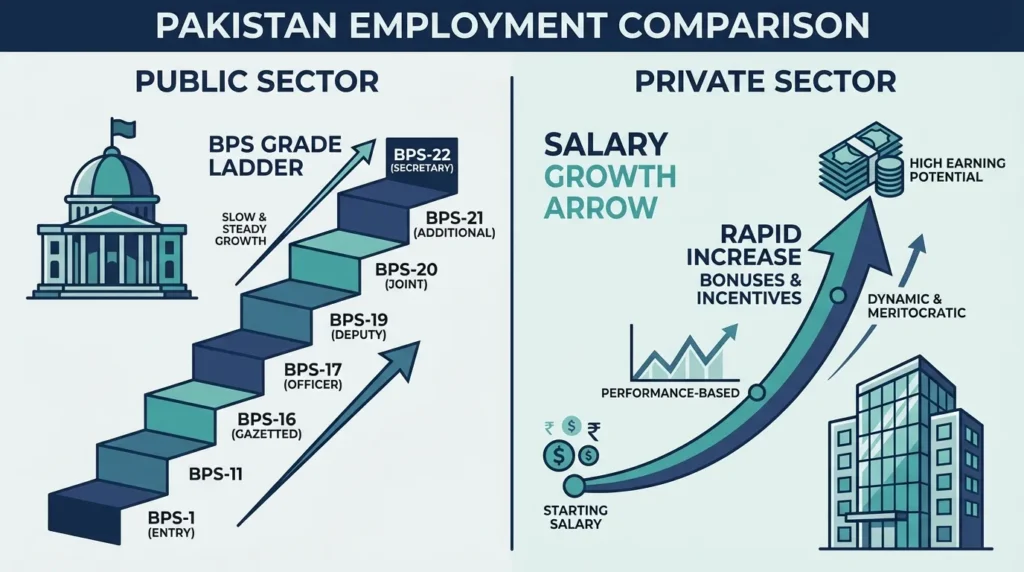
Pakistan’s public sector pays less in base salary than the private sector for comparable skill levels. Yet government jobs remain intensely competitive. The reason: total compensation tells a different story.
Basic Pay Scale (BPS) System
Government employees are paid according to the Basic Pay Scale (BPS) system, which runs from BPS-1 (lowest clerical/support staff) to BPS-22 (Federal Secretary level). Use our pay scale table to look up exact figures for every BPS grade. Here’s a summary:
| BPS Grade | Role Type | Approx. Monthly Salary (PKR) |
|---|---|---|
| BPS-1 to BPS-4 | Peon, Guard, Naib Qasid | 25,000–35,000 |
| BPS-5 to BPS-10 | Clerk, Operator, Technician | 35,000–60,000 |
| BPS-11 to BPS-16 | Assistant, Junior Officer | 60,000–110,000 |
| BPS-17 | Officer (Entry) | 90,000–130,000 |
| BPS-18 | Senior Officer | 120,000–175,000 |
| BPS-19 to BPS-20 | Deputy Secretary / Director | 175,000–280,000 |
| BPS-21 to BPS-22 | Additional Secretary / Secretary | 280,000–450,000+ |
Why Government Jobs Stay Popular
Government employment in Pakistan comes with pension, job security, housing allowance, medical coverage, and loan facilities — benefits the private sector doesn’t match at lower pay grades. A BPS-17 officer earning PKR 120,000 in cash effectively earns more in total compensation than a private sector counterpart at PKR 150,000 with no benefits. This is why CSS, PMS, and federal government positions remain among the most competitive exams in the country. If you’re preparing for FPSC exams, check your FPSC age eligibility before applying — age limits disqualify a large share of applicants before the test stage.
Freelance & Remote Work Salaries in Pakistan
Pakistan’s freelance economy is significant. According to Payoneer and Freelancer.com data, Pakistan consistently ranks among the top 5 countries globally for freelance earnings volume. Freelancers operate across software development, graphic design, content writing, digital marketing, and virtual assistance.
Freelance income bypasses domestic wage ceilings entirely because payment is in USD, EUR, or GBP.
| Freelance Role | Typical Monthly Income (USD) | PKR Equivalent (approx.) |
|---|---|---|
| Software Developer | 1,500–5,000 | 420,000–1,400,000 |
| Graphic Designer | 500–2,000 | 140,000–560,000 |
| Content Writer (English) | 400–1,500 | 112,000–420,000 |
| Digital Marketer / SEO | 600–2,500 | 168,000–700,000 |
| Virtual Assistant | 300–900 | 84,000–252,000 |
| Video Editor | 500–2,000 | 140,000–560,000 |
A mid-level Pakistani freelancer earns 3–5x the domestic average salary for equivalent skill levels. This is the primary reason talent is migrating from traditional employment to freelance work, particularly in the tech and creative sectors.
Salary Deductions and Net Take-Home Pay
Gross salary is what’s offered. Net salary is what’s deposited. The difference matters.
Income Tax Slabs 2025–2026 (Salaried Individuals)
Pakistan uses a progressive tax system. Here are the applicable tax slabs for salaried workers as per FBR for FY 2025–2026:
| Annual Income (PKR) | Tax Rate |
|---|---|
| Up to 600,000 | 0% |
| 600,001 – 1,200,000 | 5% on amount above 600,000 |
| 1,200,001 – 2,200,000 | PKR 30,000 + 15% above 1,200,000 |
| 2,200,001 – 3,200,000 | PKR 180,000 + 25% above 2,200,000 |
| 3,200,001 – 4,100,000 | PKR 430,000 + 30% above 3,200,000 |
| Above 4,100,000 | PKR 700,000 + 35% above 4,100,000 |
Workers earning PKR 50,000/month (PKR 600,000/year) pay zero income tax. Workers earning PKR 100,000/month (PKR 1,200,000/year) pay around PKR 30,000 per year — or PKR 2,500/month in tax. Run your exact liability using our income tax calculator — it applies the current FBR slabs automatically.
EOBI, ESSI, and Other Deductions
Beyond income tax, formal employees face:
- EOBI (Employees’ Old Age Benefits Institution): Employee contributes 1% of minimum wage (~PKR 370/month). Employer contributes 5%. Use our EOBI calculator to find your exact monthly contribution based on your salary.
- ESSI (Employees’ Social Security): Applied in Punjab and Sindh; employee contributes PKR 0–30/month, employer contributes 6% of wages.
- WPPF (Workers’ Profit Participation Fund): Companies with profits above threshold allocate 5% of net profit to workers.
Net Salary Calculation Example
Let’s run a real example:
Profile: Marketing manager, Lahore, private sector, 6 years of experience Gross Monthly Salary: PKR 150,000
| Deduction | Monthly Amount |
|---|---|
| Income Tax | ~PKR 6,250 |
| EOBI | ~PKR 370 |
| ESSI (if applicable) | ~PKR 0–30 |
| Total Deductions | ~PKR 6,650 |
| Net Take-Home Pay | ~PKR 143,350 |
At PKR 150,000 gross, the effective deduction is around 4.4%. Pakistan’s relatively low formal tax burden at mid-salary levels means gross and net figures don’t diverge dramatically until you cross PKR 200,000/month. For a full breakdown of your own package, our salary calculator handles gross-to-net conversion with all applicable deductions.
Cost of Living vs. Salary — Can You Live Comfortably?
The average salary of PKR 82,100 covers basic needs in most Pakistani cities — but comfortably is a relative term.
A family of four in Lahore or Karachi needs roughly PKR 120,000–160,000/month to maintain a middle-class standard of living — rent, food, schooling, utilities, transport, and modest savings. A single person living frugally in a mid-tier city can manage on PKR 45,000–60,000.
| Expense Category | Lahore (PKR/month) | Karachi (PKR/month) |
|---|---|---|
| Rent (2BR apartment) | 40,000–80,000 | 55,000–110,000 |
| Groceries (family of 4) | 25,000–35,000 | 28,000–40,000 |
| Utilities (electricity, gas, water) | 8,000–20,000 | 10,000–22,000 |
| Transport | 8,000–15,000 | 10,000–18,000 |
| Children’s schooling (private) | 15,000–40,000/child | 20,000–60,000/child |
On the median salary of PKR 70,700, a family covering all these basics is running tight. Savings are limited unless both partners work. This is the economic reality for most households — dual income isn’t a lifestyle choice; it’s a financial necessity.
Real Wage Growth vs. Inflation (2015–2026)
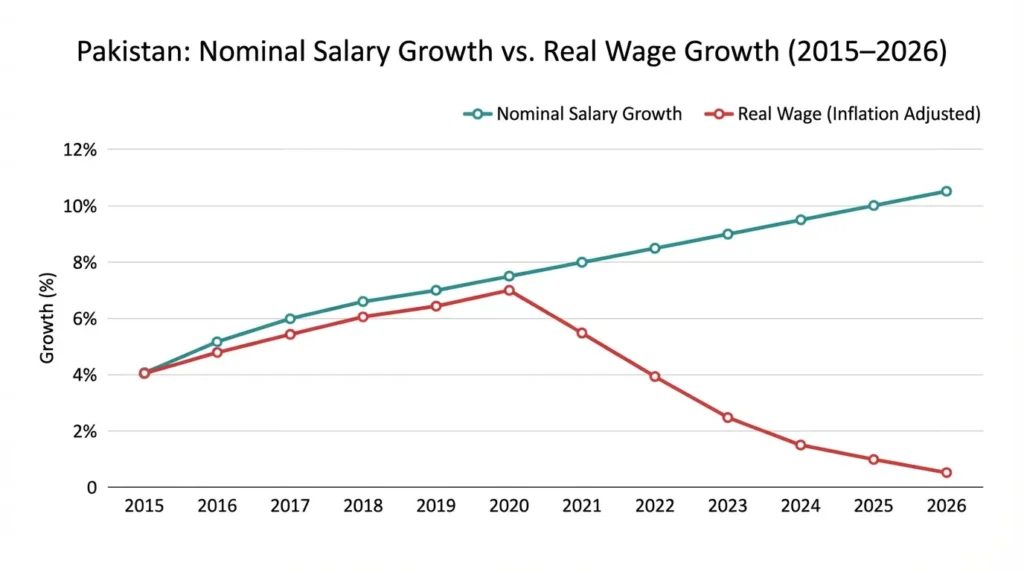
Nominal salaries in Pakistan have increased since 2015. Real wages — adjusted for inflation — have not kept pace.
Between 2020 and 2024, Pakistan experienced inflation above 20% in back-to-back years. In FY 2022–23, CPI inflation peaked at 29.2%. Salaries across most sectors rose by 10–15% during this period, meaning real purchasing power declined sharply for most workers.
A worker earning PKR 82,100 today does not have the same purchasing power as someone earning PKR 82,100 in 2019. In real terms, that 2019 salary would be equivalent to approximately PKR 175,000–190,000 in 2025 rupees.
The practical outcome: salaries have risen nominally but many workers are effectively poorer in real terms than they were five years ago. Industries that have matched inflation — IT, telecom, senior banking — are retaining talent. Industries that haven’t — public education, agriculture, lower-tier manufacturing — face high turnover and worker distress.
Pakistan Salary vs. Regional Countries
For employers considering Pakistan as an outsourcing or remote hiring destination, here’s how salaries compare:
| Country | Avg. Monthly Salary (USD) |
|---|---|
| Pakistan | ~292 |
| Bangladesh | ~210 |
| India | ~540 |
| Philippines | ~430 |
| Vietnam | ~380 |
| Ukraine | ~550 |
| Nepal | ~180 |
Pakistan is cost-competitive with India and Southeast Asia while offering an English-proficient, technically trained workforce. For software development, customer support, and digital services, Pakistan offers strong value relative to output quality.
Salary Outlook for 2026 — Which Sectors Are Growing?
Three sectors are likely to see above-average salary growth in 2026:
IT & Technology: Pakistan’s IT exports crossed USD 3.2 billion in FY 2024. Government initiatives — Pakistan Software Export Board (PSEB), Special Technology Zones Authority (STZA) — are actively expanding the sector. Demand for software engineers, data scientists, and cybersecurity professionals is outpacing local supply, pushing salaries up.
Healthcare: A growing middle class is driving private hospital expansion. Specialist doctors and trained nurses are in shortage. Medical salaries — especially in private sector hospitals in Karachi and Lahore — are expected to rise 12–18% in 2026.
Renewable Energy: Pakistan’s push toward solar and wind energy is creating demand for electrical engineers, energy consultants, and project managers. These roles currently pay PKR 100,000–300,000 and the sector is hiring aggressively. Check our jobs board for current openings in these growing fields.
Sectors where salary growth is likely to remain flat or lag inflation: agriculture, public education, lower-tier retail, and textiles. These industries face structural cost pressures and don’t have the foreign revenue component that allows IT and healthcare to grow pay.
Frequently Asked Questions
What is the average salary in Pakistan per month?
PKR 82,100 per month (approximately USD 292) as of 2025–2026. The median — a more representative figure — is PKR 70,700.
What is the minimum wage in Pakistan in 2025?
PKR 37,000/month in Punjab, Sindh, and the Federal Capital Territory. KPK sets it at PKR 36,000. Balochistan has the lowest floor at PKR 32,000.
What is the highest-paying job in Pakistan?
Specialist surgeons and doctors earn the most overall — PKR 500,000–1,200,000 per month. Among private sector professionals, senior software engineers, investment bankers, and airline pilots also reach the top ranges.
What is a good salary in Pakistan in 2025?
A salary above PKR 150,000/month puts someone in the top 20–25% of earners. PKR 250,000+ per month is solidly upper-middle-class in most cities. In Karachi and Islamabad, PKR 200,000 is a comfortable professional salary for a single person.
How much do freelancers earn in Pakistan?
Mid-level freelancers earn USD 800–2,500/month depending on skill and niche. Senior software developers and digital marketers billing international clients regularly exceed USD 3,000–5,000/month — PKR 850,000–1,400,000 at current rates.
Do women earn less than men in Pakistan?
Yes. Women earn approximately 25–35% less than men for comparable work on average. The gap narrows in formal professional sectors but widens significantly in informal and agricultural employment.
How much tax is deducted from salary in Pakistan?
Workers earning up to PKR 600,000/year (PKR 50,000/month) pay zero income tax. Above that, rates range from 5% to 35% progressively. Use our income tax calculator to find your exact monthly deduction instantly.
How do I calculate my EOBI contribution?
Your EOBI contribution as an employee is approximately PKR 370/month. Use the EOBI calculator to verify the exact figure based on your current salary and employer type.
Conclusion
The average salary in Pakistan — PKR 82,100/month — is a national headline figure. The reality underneath it is more nuanced. Where you work, what you do, which city you’re in, and how much experience you carry all move that number dramatically in either direction.
The clearest patterns: IT and medicine pay the most. Agriculture and lower-tier manufacturing pay the least. Karachi and Islamabad pay more than Peshawar and Faisalabad. Freelancers billing in foreign currency earn multiples of domestic benchmarks. And real wages, despite rising in nominal terms, have not kept pace with Pakistan’s inflation cycle of the early 2020s.
For job seekers, the median of PKR 70,700 is the honest benchmark — not the average. Use our salary calculator to work out your exact gross-to-net figure, and browse current job listings to see what employers in your field are posting today.
