Gratuity is a one-time payment your employer owes you at the end of your service. Not a bonus. Not goodwill. A legal right under Pakistani labour law. If you have completed five or more years at a company, you are almost certainly entitled to it. This article covers who qualifies, how to calculate the exact amount, how resignation and termination differ, and what to do if your employer refuses to pay.
What Is Gratuity?
Gratuity is a lump-sum amount paid to an employee when they leave a job after completing a minimum period of service. It recognises years of continuous contribution to an organisation.
It is separate from your monthly salary, provident fund, or EOBI contributions. It is not severance — though some employers pay both together. And unlike a performance bonus, it does not depend on company results or manager discretion.
One thing to understand from the start: gratuity is calculated on your basic salary only. House rent allowance, medical allowance, fuel, and other benefits are excluded entirely.
Laws That Govern Gratuity in Pakistan

The main law is the West Pakistan Industrial and Commercial Employment (Standing Orders) Ordinance, 1968. It applies to industrial and commercial establishments with 20 or more workers. This Ordinance defines the framework for gratuity entitlement in the private sector.
Three other laws are relevant:
- Payment of Wages Act, 1936 — governs timely payment of terminal benefits including gratuity
- Income Tax Ordinance, 2001 — determines how gratuity is taxed at the time of payment
- Companies Profits (Workers’ Participation) Act, 1968 — relevant where profit-sharing coexists with gratuity
After the 18th Constitutional Amendment in 2010, labour became a provincial subject. Punjab, Sindh, KPK, and Balochistan can now legislate their own labour rules. In practice, all four provinces have largely retained the Standing Orders Ordinance framework. But enforcement mechanisms and procedural rules vary. For anything specific to your province, check directly with your Provincial Labour Department.
Who Qualifies for Gratuity?
The 5-Year Rule
You must complete at least five years of continuous service with the same employer. This is the core condition — everything else is secondary. Resign before five years, get terminated before five years, or retire before five years, and you generally receive nothing.
“Continuous service” means unbroken employment. Short employer-approved breaks — maternity leave, medical leave, sanctioned unpaid leave — typically do not disrupt continuity.
Employment Type
The Standing Orders Ordinance covers workmen — employees engaged in manual, technical, or clerical work who are not in a managerial or administrative role. Most salaried private sector employees fall within this definition.
Employees on fixed-term contracts can also qualify if their contracts have been continuously renewed and total service exceeds five years.
Establishment Size
The Ordinance applies to establishments with 20 or more workers. If a company employs fewer than 20 people, it is not legally required to pay gratuity — unless the employment contract or company HR policy specifically commits to it.
When You Do NOT Get Gratuity
Four situations disqualify you:
- Dismissal for proven misconduct — theft, fraud, serious insubordination, or similar offences can result in full forfeiture of gratuity. A proper inquiry must have been conducted.
- Less than five years of service — no exceptions under the standard legal framework
- Establishment below the 20-worker threshold — if you are not covered by the Ordinance and your contract is silent on gratuity, there is no entitlement
- Short-term contract workers with no renewal history
One common misconception: many employees believe that resigning disqualifies them. It does not. Five completed years entitles you to gratuity regardless of whether you resigned, were terminated without cause, or retired.
How to Calculate Gratuity in Pakistan

The Formula
Gratuity = Last Drawn Basic Salary × Number of Completed Years of Service
This is the standard formula used across most private sector employers in Pakistan. Each completed year of service earns one month of basic pay.
Some employers use the daily-rate method instead:
Gratuity = (Last Drawn Basic Salary ÷ 26) × 30 × Years of Service
This breaks the monthly salary into a daily rate (26 working days assumed per month), then multiplies by 30 days for each year of service. The result is slightly higher than the simple formula.
Your employment contract or company policy determines which applies. If neither specifies, the simple formula is the safer assumption.
What Counts as Basic Salary?
Only the basic pay component — not gross salary. House rent, transport, medical, fuel, and utility allowances are excluded. If your salary slip shows multiple components, only the “Basic Pay” or “Basic Salary” line is used.
If you are unsure how your salary is structured, the salary calculator can help you break down components clearly before you run the gratuity math.
Worked Example
Assume:
- Last drawn basic salary: PKR 60,000/month
- Total completed years of service: 8 years
Simple formula: PKR 60,000 × 8 = PKR 480,000
Daily-rate formula: (PKR 60,000 ÷ 26) × 30 × 8 = PKR 2,307.69 × 30 × 8 = PKR 553,846
The difference between the two methods in this example is over PKR 73,000. Worth knowing which method your employer applies before you negotiate an exit.
Gratuity Across Three Exit Scenarios
Resignation After 5 Years
Full gratuity applies. Five completed years is the threshold — the reason for leaving does not change your entitlement. Employers cannot legally withhold gratuity from an employee who resigned after meeting the service requirement.
If you are currently evaluating whether to stay or move on, understanding your gratuity position is part of the full financial picture — alongside knowing your market rate. Our guide on salary negotiation in Pakistan covers how to approach that conversation once you know where you stand.
Termination Without Cause
If your employer terminates you without proven misconduct — restructuring, redundancy, or any non-disciplinary reason — full gratuity is payable, assuming five years of service are met. This includes situations where the company downsizes or simply chooses to let you go.
Death or Permanent Disability
If an employee dies in service or becomes permanently disabled, gratuity is paid to their legal heirs or to the employee directly. Most provincial labour rules support this exception even if five years of service have not been completed. Confirm with your provincial Labour Department, as provincial rules vary post-18th Amendment.
Government Employees vs. Private Sector

Most federal and provincial government servants do not receive gratuity. They are covered under the Civil Servants Act, 1973, which provides a monthly pension upon retirement. Some lower-grade government employees on contract arrangements may receive gratuity instead of pension, but this is the exception.
For grade-specific benefit details, check the government pay scale 2025 or use the pay scale table tool to view breakdowns by BPS grade.
Private sector employees have no pension entitlement. Their two main statutory retirement-linked benefits are gratuity and EOBI. These work differently — gratuity is a one-time payment from your employer, while EOBI is a monthly pension funded through contributions. Use the EOBI calculator to estimate your EOBI pension, and read our detailed guide on EOBI pension in Pakistan to understand how both benefits can work together for your retirement planning.
Is Gratuity Taxable in Pakistan?
Under the Income Tax Ordinance, 2001, the tax treatment depends on the source of the gratuity payment:
| Source | Tax Treatment |
|---|---|
| Federal or provincial government | Fully exempt |
| FBR-approved gratuity fund | Fully exempt |
| Unapproved fund or direct employer payment | Partially exempt — remainder added to taxable income |
Most mid-size private companies in Pakistan do not maintain an FBR-approved gratuity fund. If yours does not, only a portion of your payment is tax-free. The exemption limit is revised periodically through the Finance Act.
Before you accept a gratuity payment, ask HR whether it is coming from an approved fund or directly from company accounts. The difference can meaningfully change your tax liability. Use the income tax calculator to estimate what you will actually take home after tax.
What to Do If Your Employer Refuses to Pay
Unpaid gratuity is one of the most common labour complaints in Pakistan’s private sector. You have clear legal options.
Step 1 — Written demand. Send a formal request to HR and management in writing. Email works. This creates a dated paper trail and gives the employer a formal notice.
Step 2 — Provincial Labour Department. Each province has a Labour Department that handles terminal benefit disputes. The process is free. Bring your appointment letter, payslips, and resignation or termination letter. A conciliator can often resolve the dispute without going to court.
Step 3 — Labour Court or NIRC. If the Labour Department process fails or stalls, file before the Labour Court or the National Industrial Relations Commission (NIRC). Cases involving withheld statutory benefits are treated seriously.
Act within the limitation period. Labour laws impose time limits on claims — typically one to three years depending on provincial rules. Do not wait.
Frequently Asked Questions
Is gratuity mandatory for all private companies in Pakistan? No. The Standing Orders Ordinance applies to establishments with 20 or more workers. Smaller employers are not legally required to pay gratuity unless it is written into the employment contract.
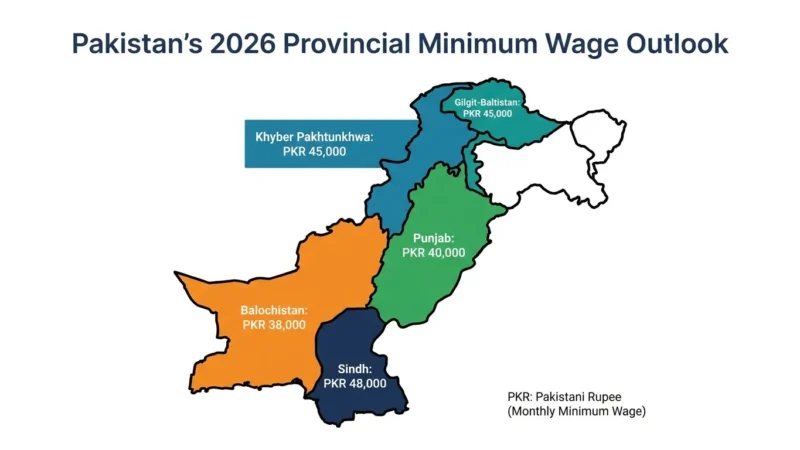
Does the minimum wage affect gratuity eligibility? Gratuity is service-based, not income-based. An employee earning the minimum wage in Pakistan can still qualify for full gratuity after five years of continuous service.
Can an employer deduct gratuity for damages? Only where a formal inquiry has been conducted and misconduct proven. Arbitrary deductions without due process are not legally valid.
Does part-time work count toward gratuity? Generally, no — unless the part-time arrangement is recognised as permanent, continuous employment under the contract and local labour rules.
What is a typical gratuity amount in Pakistan? It depends entirely on basic salary and years of service. For salary benchmarks across industries, see the data on average salaries in Pakistan.
Final Word
Gratuity in Pakistan comes down to three things: five years of service, basic salary as the base, and completed years as the multiplier. That formula holds across industries, provinces, and employment types — as long as you are covered under the Standing Orders Ordinance.
Know your rights before you resign, accept a termination, or sign any exit agreement. Gratuity is not a favour from your employer. It is money you have already earned through years of work.
If you are evaluating your next career move, understanding gratuity alongside total compensation is part of making an informed decision. Take a look at the highest paying jobs in Pakistan to see where your skills could take you — and what long-term financial benefits come with different career paths.