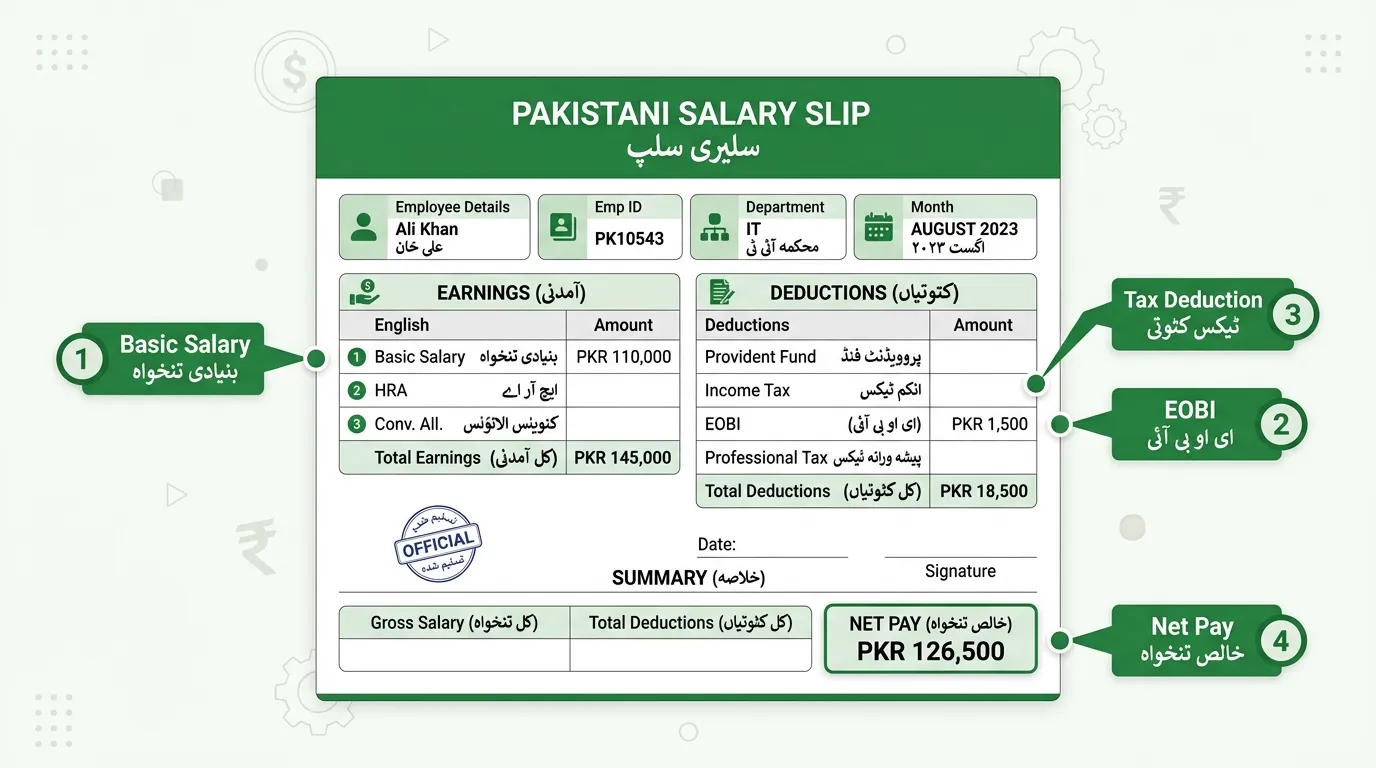
Most salaried employees in Pakistan receive a payslip every month. Most of them don’t fully understand it.
They see a number at the top, a number at the bottom, and a list of words in between that nobody explained. Basic salary. HRA. EOBI. PF. Tax deduction. Net pay. If any of those feel unfamiliar, this guide is for you.
This article breaks down every single term on a Pakistani salary slip — what it means, how it’s calculated, and why it matters. By the end, you’ll be able to read any payslip independently and verify that every figure is correct.
What Is a Payslip?
A payslip is a monthly document issued by your employer that details your earnings and deductions for that pay period. It shows how your gross salary is calculated and explains exactly why your bank account receives a lower figure.
In Pakistan, employers are legally required to provide payslips or salary statements under provincial labour laws. You may receive it as a printed document, an email attachment, or through an HR portal — depending on your company.
Keep every payslip you receive. You’ll need them for tax filing, loan applications, visa processing, and any salary dispute.
Why Your Payslip Matters More Than You Think
Your payslip is more than a record of what you were paid. It’s a legal document.
Here’s why it deserves your attention every month:
Error detection. Payroll mistakes happen — wrong tax calculations, missed allowances, incorrect EOBI deductions. You can only catch them if you know what to look for.
Tax filing. FBR requires salaried individuals to file annual returns. Your payslips serve as the base record for that.
Income proof. Banks, landlords, embassies, and visa officers all ask for salary slips. A proper payslip with official company letterhead carries legal weight.
Salary benchmarking. Understanding your salary structure helps when you’re negotiating a raise or evaluating a new offer. Knowing how your current salary compares to market averages gives you real leverage in those conversations.
The Two Sides of Every Payslip — Earnings vs. Deductions
Every payslip is divided into two core sections:
Earnings — everything your employer pays you Deductions — everything taken out before the money reaches you
Your gross salary is the total of all earnings. Your net salary is what’s left after deductions. The difference between these two numbers is what this entire guide explains.
Earnings — Every Line Item Explained
Basic Salary
Basic salary is the fixed, core component of your compensation. Everything else — allowances, PF contributions, gratuity — is often calculated as a percentage of this number.
In most Pakistani companies, basic salary ranges from 40% to 60% of gross salary. If your gross is PKR 80,000 and your basic is PKR 40,000, the remaining PKR 40,000 comes from allowances.
The federal minimum wage in Pakistan for 2024–25 is PKR 37,000 per month. No employer can legally pay below this floor.
House Rent Allowance (HRA)
HRA is a monthly payment meant to help cover housing costs. It is not part of basic salary. Most private sector employers set HRA at 40–50% of basic salary.
HRA is partially exempt from income tax under FBR rules — up to 45% of basic salary is tax-free. Anything above that threshold becomes taxable.
Conveyance Allowance
This covers daily travel to and from work. The standard tax-exempt limit for conveyance allowance is PKR 10,000 per month under current FBR rules. Amounts above that are taxed.
Medical Allowance
Your employer may pay a fixed monthly amount for medical expenses. Like conveyance, this is tax-exempt up to a limit — typically 10% of basic salary, subject to conditions.
Utility Allowance
Some companies provide a separate allowance for electricity and gas bills. It’s taxable unless the employer bundles it under an approved reimbursement policy.
Special Allowance / Other Allowances
This is a catch-all category. It may appear as “Special Allowance,” “Performance Allowance,” “Living Allowance,” or similar. Fully taxable in most cases.
Gross Salary
Gross salary is the total of all earnings listed above. It’s the number before any deductions.
Gross Salary = Basic Salary + HRA + Conveyance + Medical + Utility + All Other Allowances
This is the number you quote when someone asks your salary — but it’s not what hits your account.

Deductions — What Gets Cut and Why
Income Tax (FBR Withholding Tax)
This is the largest deduction for most employees. Under the Income Tax Ordinance 2001, employers are required to deduct income tax at source every month and deposit it with the FBR on your behalf.
The amount deducted depends on your annual taxable salary and the applicable tax slab under the Finance Act 2024. Pakistan uses a progressive slab system — the more you earn, the higher the percentage.
Important: Tax is calculated on an annualized basis and spread across 12 months. If your salary changes mid-year, your monthly tax deduction will adjust.
Use an income tax calculator for Pakistan to check whether the deduction on your payslip matches what you should actually owe.
Provident Fund (PF)
Provident Fund is a retirement savings scheme. Both you and your employer contribute monthly.
The most common structure: employee contributes 8.33% of basic salary, employer matches the same. Some companies contribute 10%.
At the end of your employment (or after a vesting period), you receive the accumulated fund with interest. It’s part of your long-term compensation, not a loss.
For a full breakdown of long-term retirement benefits in Pakistan, see our guide on EOBI pension explained.
EOBI Contribution
EOBI stands for Employees’ Old-Age Benefits Institution. It’s a federal pension program governed by the EOBI Act 1976.
Both you and your employer contribute:
- Employee contribution: 1% of monthly wages
- Employer contribution: 5% of minimum wage (PKR 37,000), i.e., PKR 1,850/month
After 15 years of contributions, you’re eligible for a monthly pension upon retirement, disability, or death (survivor’s pension for family).
You can estimate your future EOBI benefit using our EOBI calculator.
PESSI / SESSI / BESSI — Social Security Contributions
Social Security contributions in Pakistan are province-specific:
| Province | Institution | Employee Rate | Employer Rate |
|---|---|---|---|
| Punjab | PESSI | 0.75% of wages | 6% of wages |
| Sindh | SESSI | 1% of wages | 6% of wages |
| Balochistan | BESSI | 1% of wages | 5% of wages |
| KPK | KPSSA | Varies | Varies |
These funds cover medical treatment, maternity benefits, and disability support for registered workers.
Note: Not all employers are registered under Social Security. Registration is mandatory above a certain employee threshold under the West Pakistan Social Security Ordinance 1965.
Loan or Advance Recovery
If you took a salary advance or a company loan, the installment is recovered directly from your payslip. It will appear as “Loan Recovery,” “Advance Deduction,” or similar. This is not a statutory deduction — it’s specific to your agreement with your employer.

Net Salary — Your Actual Take-Home Pay
Net salary is what gets deposited into your bank account. It’s calculated as:
Net Salary = Gross Salary − Total Deductions
This is the number that matters for your monthly budget. Everything else on the payslip is context explaining how you got here.
To quickly model your take-home pay based on your salary components, try the salary calculator for Pakistan.
Taxable vs. Non-Taxable Allowances (FBR Rules)
Not all allowances are taxed equally. Here’s a quick reference:
| Allowance | Tax Status | FBR Exempt Limit |
|---|---|---|
| Basic Salary | Fully taxable | None |
| House Rent Allowance | Partially exempt | Up to 45% of basic salary |
| Conveyance Allowance | Partially exempt | Up to PKR 10,000/month |
| Medical Allowance | Partially exempt | Up to 10% of basic salary |
| Utility Allowance | Taxable | None |
| Special Allowance | Taxable | None |
These limits are set by the FBR under the Income Tax Ordinance 2001 and may update each Finance Act. Always check the current year’s rules or consult your HR department.
Province-Specific Social Security — What Changes Based on Where You Work
This is something most payslip guides skip. Your social security deduction depends on which province your employer is registered in — not where you live.
If you work in Karachi, your deduction follows SESSI rules. If your office is in Lahore, PESSI applies. For most formal sector employees, the deduction appears as a small line item, but knowing which institution governs yours matters when you need to claim benefits.
What to Do If Your Payslip Has an Error
Errors in payslips are more common than most employees realize. Here’s a practical approach:
Step 1. Compare your current payslip with last month’s. Flag any unexplained changes in allowances or deductions.
Step 2. Cross-check income tax using a tax calculator. If the deducted amount differs significantly, request your employer’s tax calculation sheet.
Step 3. Verify EOBI and social security deductions against the rates in this article. If your employer is registered, deductions should match statutory rates.
Step 4. Put your concern in writing to HR. Email creates a paper trail. Verbal complaints are easy to ignore.
Step 5. If the issue is unresolved, you can file a complaint with EOBI, your provincial Social Security institution, or the relevant labour court.
Your salary is a legally binding agreement. You have the right to a correct, transparent payslip.
Using Your Payslip as Proof of Income
Banks, mortgage lenders, VISA officers, and landlords all ask for salary slips. Here’s what makes a payslip acceptable as formal proof:
- Company name and official letterhead
- Employee name and ID
- Month and year clearly stated
- Gross and net salary both shown
- Employer stamp or authorized signature
Three consecutive payslips are the standard ask for most loan and visa applications. If your company issues digital payslips without a signature, request a stamped letter from HR confirming your salary — most institutions accept this alongside the digital slip.
Government Employees — A Different Pay Structure
If you work in the federal or provincial government, your payslip follows the Basic Pay Scale (BPS) system. Your basic pay depends on your grade (BPS-1 to BPS-22) and years of service.
The government pay scale table for 2025 shows the exact basic pay and allowance figures for each grade. Government employees also receive different allowances — ad hoc relief, medical facility allowance, and house rent based on city category.
A Note on Gratuity
Gratuity doesn’t appear on your monthly payslip, but it’s part of your total compensation. Under the gratuity law in Pakistan, employees who complete one year of service are entitled to gratuity upon leaving — calculated as 30 days’ basic salary per year of service.
It’s worth knowing, especially if you’re evaluating a job offer or planning to resign.
Frequently Asked Questions
What is the difference between gross salary and net salary in Pakistan? Gross salary is your total earnings before any deductions — the sum of basic pay and all allowances. Net salary is what you actually receive after income tax, EOBI, provident fund, and social security contributions are deducted.
Is EOBI deduction mandatory for all employees in Pakistan? Yes. Any employer with 5 or more employees is required to register with EOBI and make monthly contributions under the EOBI Act 1976. The employee pays 1% of wages; the employer pays 5% of the minimum wage.
How is income tax calculated on salary in Pakistan? Your employer calculates your projected annual salary, applies the applicable FBR tax slab for that income range, divides the annual tax by 12, and deducts that amount monthly. Tax slabs are revised each year in the Federal Budget.
Can my employer deduct more than what’s shown on my payslip? No. Every deduction must be itemized on your payslip. Unauthorized deductions are illegal under Pakistan’s Payment of Wages Act.
What should I do if I don’t receive a payslip? Request one in writing from HR. If the employer refuses, this is a violation of labour regulations. You can report it to the Provincial Labour Department.
Final Takeaway
A payslip is not just a receipt. It’s a breakdown of a legal obligation your employer has to you.
Basic salary sets the foundation. Allowances build on top of it. Deductions — tax, EOBI, PF, and social security — are statutory obligations that protect you in the long run, even if they reduce your monthly take-home.
Read your payslip every month. Cross-check the figures. And if something doesn’t match, ask — in writing.